Commercial Trampoline Park Investment Guide
2026年11月9日 / By safekidsplay_admin

Quick Answer
A commercial trampoline park investment should be evaluated by matching the target market, building, attraction mix, total project scope, and operating capability. Investors should budget for venue and fit-out, equipment, design, shipping, installation, local works, pre-opening costs, and ongoing operations. The site must support the intended activities, clear height, customer flow, supervision, maintenance access, and delivery route. Before committing, buyers should validate local demand and compare supplier proposals by complete scope rather than relying on a generic investment or ROI promise.
Is a Trampoline Park a Good Investment for This Market?
A trampoline park may suit a market with demand for active family entertainment, parties, group activities, or teen-focused experiences. However, the decision depends on local competition, customer spending, transport access, available venue options, seasonality, and the operator’s ability to manage active attractions.
Research the catchment area and define the primary customer group before choosing equipment. Consider whether the venue will focus on walk-in visits, parties, memberships, school groups, events, or a mix. These choices shape the layout, operating hours, pricing strategy, and support spaces.
How Should Investors Estimate the Total Investment?
Build the budget around the whole project: venue and lease, fit-out, trampoline and challenge equipment, custom design, packing, freight, unloading, installation, local construction or utilities, pre-opening staffing, insurance, marketing, and working capital. Some costs may be quoted by the equipment supplier, while others need local contractors or professional advice.
Use a scope table that labels each item as included, excluded, estimated, or pending confirmation. This is particularly important for international projects, where freight, customs, local delivery, site access, and installation arrangements can change the total cost. Do not treat the equipment quotation as the entire investment.
How Should Investors Choose a Venue?
Check usable area and clear height against the selected activities. Map beams, ducts, lights, sprinklers, columns, exits, floor conditions, and access routes. Also confirm how equipment packages will enter the building, whether the loading route has restrictions, and whether local building systems or landlord conditions affect the design.
Site suitability includes more than dimensions. Review visibility, access, parking or public transport, nearby competition, neighboring tenants, noise expectations, operating-hour restrictions, and the practical customer journey. The building should support both the attraction plan and the business model.
What Trampoline Park Equipment Should Be Included?
Start with a clear core attraction and add complementary zones based on the target users and available building. Options may include main jump courts, dodgeball, basketball or dunk activities, landing features, ninja or challenge elements, and support spaces for reception, parties, waiting, and storage. Not every venue needs every category.
Review each option for footprint, height, supervision, expected use, inspection, cleaning, maintenance, and replacement parts. Confirm how zones connect and where users enter and exit. A smaller, coherent attraction mix can be easier to operate than a large list of activities that compete for staff and circulation.
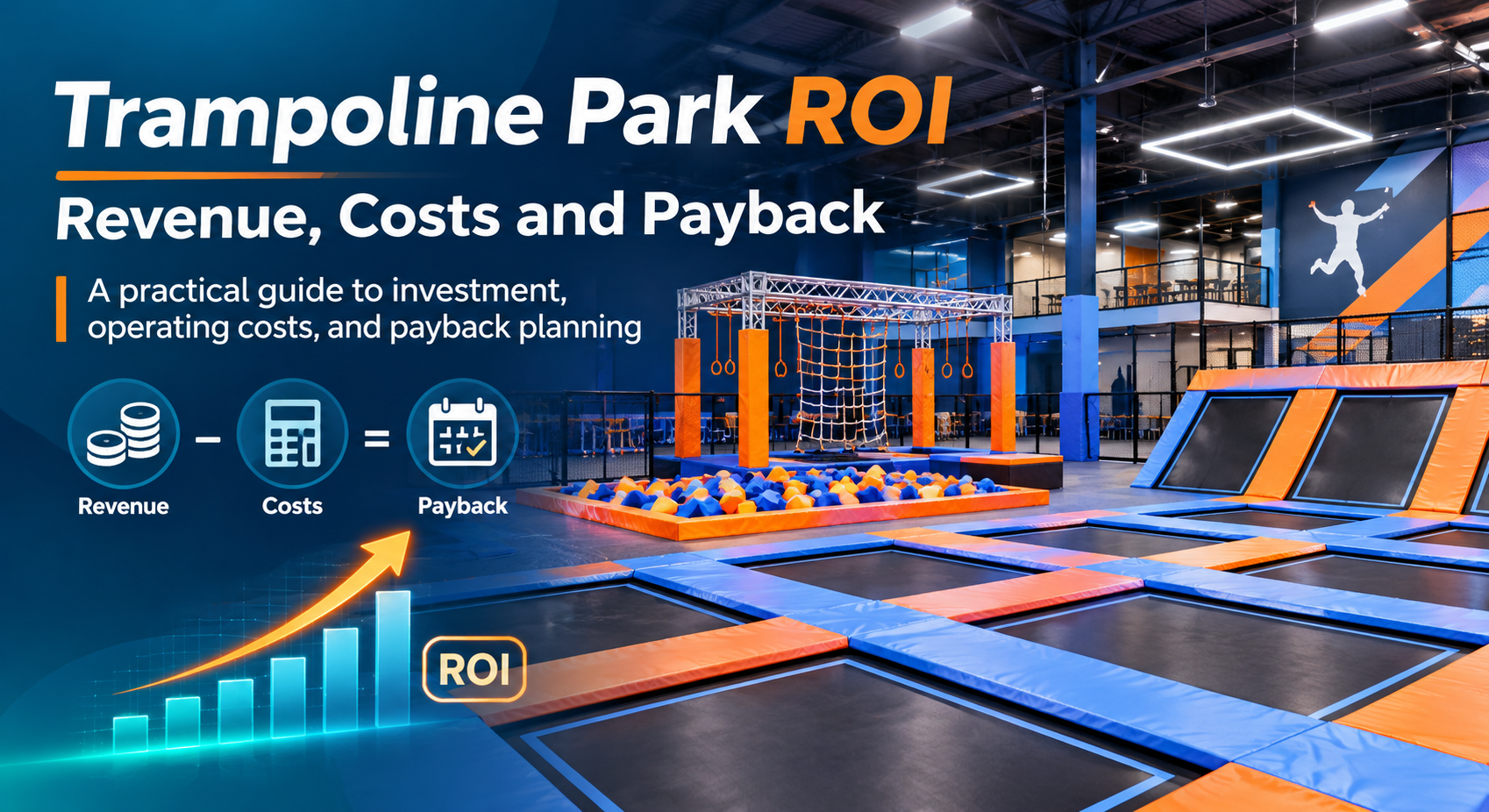
How Should Investors Estimate Revenue and ROI?
Estimate revenue streams separately: admissions, memberships, parties, groups, events, and food or beverage where suitable. Use assumptions based on local market research and the intended operating schedule. Document how prices, visits, party utilization, and seasonal patterns were estimated.
Then subtract the costs included in the model, such as rent, payroll, utilities, insurance, cleaning, marketing, maintenance, replacement parts, and other local expenses. Define whether the result is operating profit, net profit, or cash flow before calculating ROI or payback. Use downside scenarios and avoid treating forecast outputs as guaranteed outcomes.
What Safety and Operating Costs Should Be Planned?
Operating costs include more than utilities and payroll. Trampoline attractions require an equipment-specific inspection and maintenance routine, staff training, participant orientation, cleaning, replacement planning, and procedures for taking damaged areas out of service. The exact requirements depend on the equipment and local operating context.
Confirm which documents the supplier provides and which building, fire, insurance, accessibility, and authority requirements need local review. Equipment-related documents do not replace the owner’s responsibilities for the venue, staff, operating procedures, and local approvals.
How Can an Indoor Trampoline Park Fit a Larger Commercial Indoor Playground?
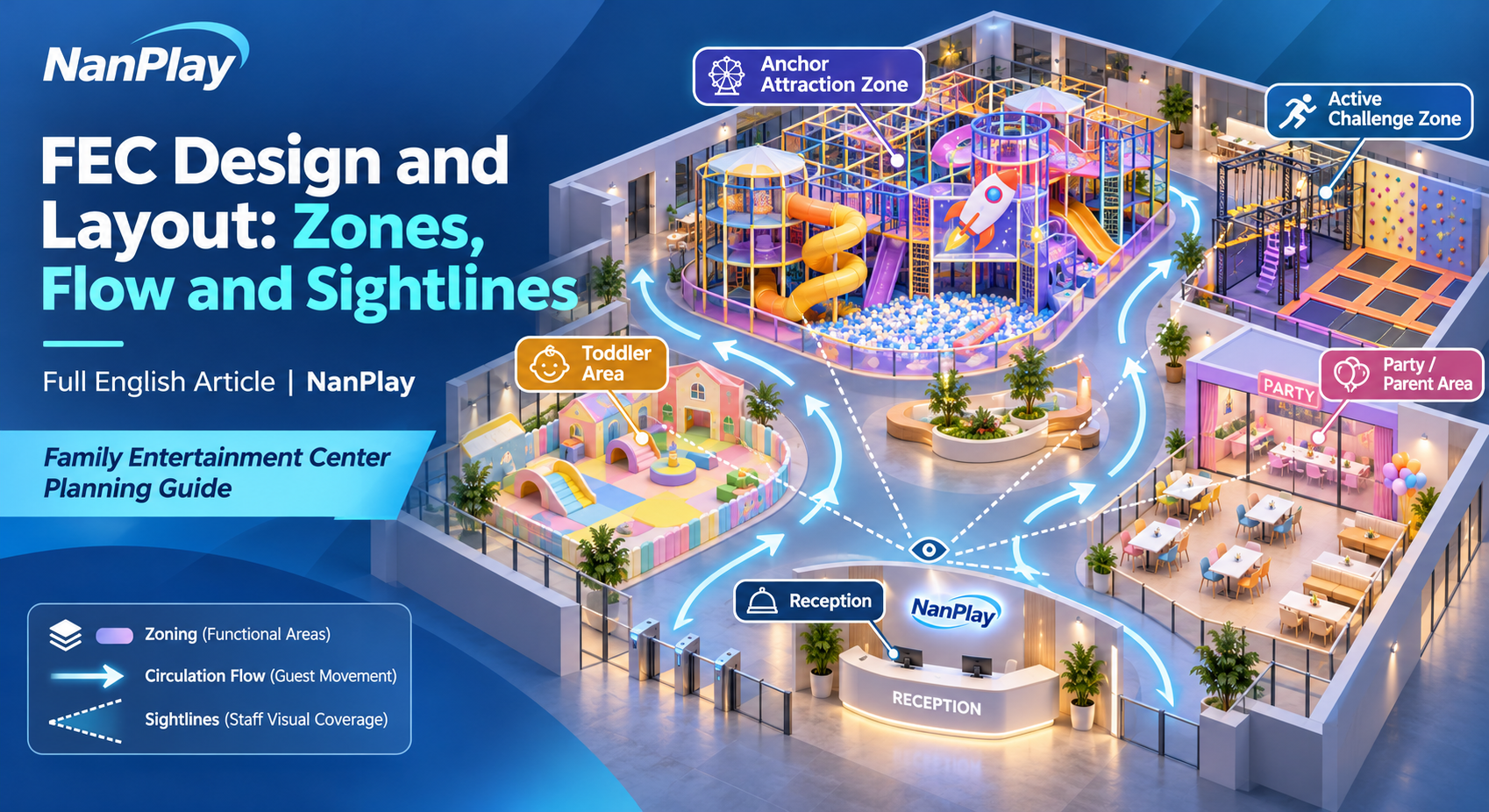
Some projects combine trampoline activities with soft play, climbing, ninja challenges, interactive attractions, toddler areas, and party functions. A hybrid concept can broaden the visit offer, but it also creates more complex zoning, supervision, maintenance, and circulation needs.
Choose complementary activities rather than adding zones simply to increase the equipment count. Separate different activity intensities where appropriate, protect sightlines, plan queueing and transition areas, and confirm that the clear height and building services support every proposed attraction. The operator should be able to staff and maintain the entire mix.
What Investment Mistakes Should Buyers Avoid?
Common mistakes include selecting a building before checking height and access, forecasting demand without local research, comparing supplier prices with different scopes, overlooking shipping and local works, and assuming that a large attraction list will automatically create more revenue.
Before ordering, verify the floor plan, equipment schedule, specifications, installation model, payment milestones, change process, spare parts, warranty terms, and handover documents. The investment case should be reviewed by the people responsible for finance, operations, site delivery, and local compliance—not only by the equipment buyer.
Decision Table: What Buyers Should Compare
| Investment Check | What to Verify | Evidence or Output |
| Market fit | Customer groups, competition, access and visit occasions | Market research and business model |
| Building fit | Area, clear height, columns, exits and loading route | Measured floor plan and site review |
| Equipment scope | Attractions, specifications, supervision and maintenance | Final equipment schedule and drawings |
| Project delivery | Design, production, freight, installation and local works | Milestone plan and responsibility matrix |
| Operating model | Staffing, inspections, cleaning, pricing and cash flow | Operating budget and scenario forecast |
What Information Should Buyers Prepare?
Prepare the destination country and city, venue type, dimensioned floor plan, usable area, clear height, columns, entrances and emergency exits, target age groups, preferred attractions, theme direction, budget range, installation preference, and planned opening date. For a more accurate review, also provide any landlord restrictions, site photos, and the current building or CAD drawings available.
Common Mistakes to Avoid
- Choosing a venue before checking clear height and delivery access.
- Assuming investment or payback can be estimated without a defined scope.
- Adding attractions without considering staff, maintenance, and customer flow.
- Leaving shipping, unloading, and local construction outside the budget.
- Treating equipment compliance documents as approval for the entire venue.
Frequently Asked Questions
How much does it cost to invest in a trampoline park?
The amount depends on venue, fit-out, equipment, customization, shipping, installation, local works, and pre-opening costs. Request a project-specific estimate.
Is a trampoline park profitable?
Profitability depends on local demand, pricing, utilization, rent, staffing, maintenance, and management; it is not guaranteed by equipment selection.
How much space is required?
The required area and clear height depend on the selected attractions, support functions, circulation, exits, and local requirements.
What equipment does a commercial trampoline park need?
Common options include main jump courts and selected games, landing, challenge, reception, and party functions, depending on the venue and target users.
What should buyers send before requesting a quote?
Send the location, floor plan, area, clear height, columns, exits, target users, preferred attractions, budget, installation preference, and opening date.
Commercial Buyer Checklist
- Market and target customer validated
- Venue dimensions and clear height checked
- Loading and installation access confirmed
- Core attraction and optional zones prioritized
- Total project budget includes non-equipment costs
- Supplier quote compared by inclusions and exclusions
- Supervision and maintenance plan prepared
- Local building and operating requirements assigned
- ROI assumptions and downside scenarios documented
- Final equipment scope and handover responsibilities approved
Final Thoughts
Commercial Trampoline Park Investment Guide should be treated as a project decision supported by site data, written scope, and realistic operating assumptions. NanPlay recommends connecting design, equipment specifications, delivery responsibilities, and maintenance planning before the project is released for production.
Project CTA
To discuss a commercial trampoline park project, share your destination country and city, floor plan, usable area, clear height, columns and exits, target age groups, preferred attractions, budget range, and planned opening date.
Reference: https://www.nanplay.com/trampoline-park/