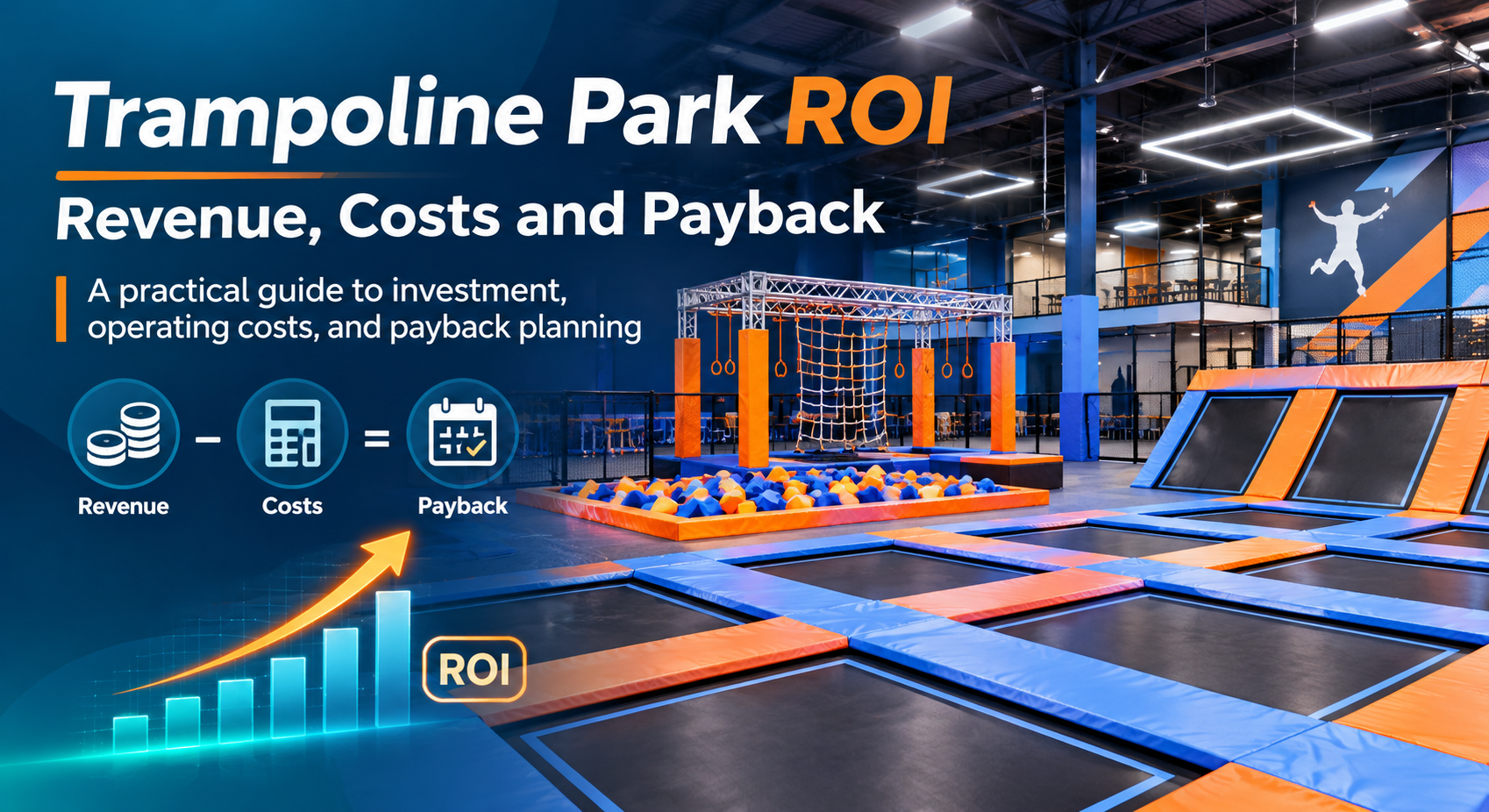
Trampoline Park ROI: Revenue, Costs and Payback
2026年11月6日 / By safekidsplay_admin
Quick Answer
Trampoline park ROI should be calculated from the venue’s own investment, realistic revenue assumptions, operating costs, and cash flow—not from a universal payback promise. Revenue may come from admission, memberships, parties, group bookings, events, and food or beverage where the business model supports them. Costs can include rent, payroll, utilities, insurance, cleaning, marketing, maintenance, replacement parts, financing, and local operating expenses. Equipment influences the customer offer and operating needs, but profitability also depends on location, pricing, utilization, staffing, and management.
How Does a Trampoline Park Make Money?
Admission is often the core revenue stream, but operators may also plan memberships, birthday parties, school or group sessions, private events, and food or beverage sales where permitted and practical. Each stream should have a defined offer, price, operating process, and way to measure actual sales.
Do not assume every stream will perform equally. Estimate demand using the local market, competitors, catchment area, opening hours, customer age mix, and available party or event capacity. Keep assumptions visible so they can be updated after the venue begins operating.
What Are the Main Startup Costs?
Startup costs can include the venue and lease, renovation, trampoline and challenge equipment, design, packing, shipping, unloading, installation, local contractor work, pre-opening staffing, insurance, marketing, software, and working capital. The mix depends on the building and the selected attraction package.
Ask suppliers to separate equipment, design, shipping, and installation scope. Also identify which tasks belong to local contractors or authorities. A reliable initial investment model should include the whole opening plan, not just the equipment invoice.
What Are the Main Operating Costs?
Recurring costs may include rent, payroll, utilities, cleaning, maintenance, replacement parts, insurance, marketing, payment processing, software, consumables, and other local expenses. Some costs vary with visitor volume; others remain relatively fixed even during slower periods.
Use the actual staffing and operating schedule to estimate costs. A larger attraction mix may require more supervision positions, inspections, cleaning, and maintenance. Reserve budget for repairs and downtime rather than assuming the equipment will never need attention.
How Do You Calculate Trampoline Park ROI?
First, define the investment base. Decide whether it includes equipment only or also renovation, design, shipping, installation, deposits, pre-opening costs, and other capital expenditure. Then estimate revenue and subtract the operating costs included in the chosen measure.
A simplified ROI measure is annual profit divided by the defined investment base. A payback estimate compares the initial investment with expected annual net cash flow. These measures are not interchangeable, and they can be distorted if financing, taxes, depreciation, owner compensation, or working capital are omitted. Document the method and use realistic scenarios.
What Affects Indoor Trampoline Park Profitability?
Location affects access, visibility, competition, and the size of the potential customer base. Pricing must fit the local market and the length or type of visit. Capacity and utilization depend on the layout, operating hours, staff procedures, and the mix of activities available.
Equipment selection matters because it shapes the customer offer and the venue’s operating demands. High-energy attractions may need stronger supervision and more frequent component checks. A good investment decision balances appeal with maintenance, staff capability, space efficiency, and the venue’s ability to run the attraction consistently.
How Does Trampoline Park Equipment Affect Revenue?
Equipment can support different visit reasons: open jump, games, skill practice, parties, group sessions, or repeat visits. A balanced attraction mix may serve more than one customer segment, but only if the building and operating model support those activities.
Evaluate each zone by its intended audience, space requirement, throughput, supervision, maintenance, and ability to connect to party or group offers. Avoid assuming that adding more attractions automatically increases revenue. The operator needs to validate whether customers will use them and whether the venue can staff them properly.
How Can Operators Improve Profitability?
Start with measured operating data: visits by day and time, average transaction value, party inquiries and bookings, membership use, repeat visits, labor hours, utilities, maintenance incidents, and downtime. Use those figures to identify where the business model differs from the original assumptions.
Possible improvements include clearer party packages, better booking processes, targeted off-peak offers, membership options, group sales, improved customer flow, and preventive maintenance. Test one change at a time and measure the effect. Do not reduce necessary supervision, inspections, or maintenance to improve a short-term margin.
How Does a Trampoline Park Compare With Other FEC Models?
A trampoline-led venue generally emphasizes active jumping and challenge activities. A broader Commercial Indoor Playground or FEC may combine soft play, toddler zones, climbing, interactive attractions, role play, and family functions. Each model attracts a different mix of users and has different staffing, maintenance, and space needs.
Compare models using the same framework: target customer, site fit, attraction investment, operating costs, supervision, repeat-visit potential, party demand, and local competition. The strongest model is the one supported by the building, the market, and the operator’s capabilities.
Decision Table: What Buyers Should Compare
| Model Input | What to Measure | Why It Matters |
| Revenue | Admissions, memberships, parties, groups and events | Shows which streams support sales |
| Fixed costs | Rent, base payroll, insurance and software | Defines the cost burden in slower periods |
| Variable costs | Consumables, payment fees and volume-related labor | Changes with operating activity |
| Equipment and downtime | Maintenance, parts, inspections and closures | Affects customer availability and cost |
| Cash flow | Timing of investment, receipts and payments | Supports payback and financing decisions |
What Information Should Buyers Prepare?
Prepare the destination country and city, venue type, dimensioned floor plan, usable area, clear height, columns, entrances and emergency exits, target age groups, preferred attractions, theme direction, budget range, installation preference, and planned opening date. For a more accurate review, also provide any landlord restrictions, site photos, and the current building or CAD drawings available.
Common Mistakes to Avoid
- Using a generic ROI or payback claim instead of a venue-specific model.
- Counting revenue streams without validating local demand.
- Leaving rent, payroll, maintenance, and working capital out of the calculation.
- Comparing equipment packages without considering supervision and upkeep.
- Reducing safety-related operating procedures to improve short-term margins.
Frequently Asked Questions
Are trampoline parks profitable?
They can be, but results depend on location, demand, pricing, utilization, rent, staffing, maintenance, and management.
What is the ROI of a trampoline park?
ROI varies by project and calculation method. Define the investment base, profit measure, time period, and excluded costs before comparing results.
How much can a trampoline park make?
Revenue depends on visitors, prices, memberships, parties, groups, operating hours, and local market conditions. Use a project-specific forecast.
How long is the payback period?
It depends on the initial investment and net cash flow. Use conservative scenarios and document financing, tax, and working-capital assumptions.
How does equipment affect profitability?
Equipment affects the customer offer, space use, supervision, maintenance, and repeat-visit options, but it does not determine business results by itself.
Commercial Buyer Checklist
- Investment base clearly defined
- Revenue streams estimated separately
- Local demand and competitors reviewed
- Fixed and variable costs listed
- Staffing and supervision costs included
- Maintenance and downtime assumptions included
- Low, expected, and high scenarios calculated
- ROI and payback formulas documented
- Equipment mix matches target users and site
- Actual operating data will be reviewed after opening
Final Thoughts
Trampoline Park ROI: Revenue, Costs, and Payback should be treated as a project decision supported by site data, written scope, and realistic operating assumptions. NanPlay recommends connecting design, equipment specifications, delivery responsibilities, and maintenance planning before the project is released for production.
Project CTA
For a project-specific trampoline park plan, share the location, floor plan, usable area, clear height, target users, attraction priorities, planned operating model, budget, and opening date.
Reference: https://www.nanplay.com/trampoline-park/