Indoor Playground Project Timeline: Key Stages Explained
2026年10月29日 / By safekidsplay_admin
Quick Answer
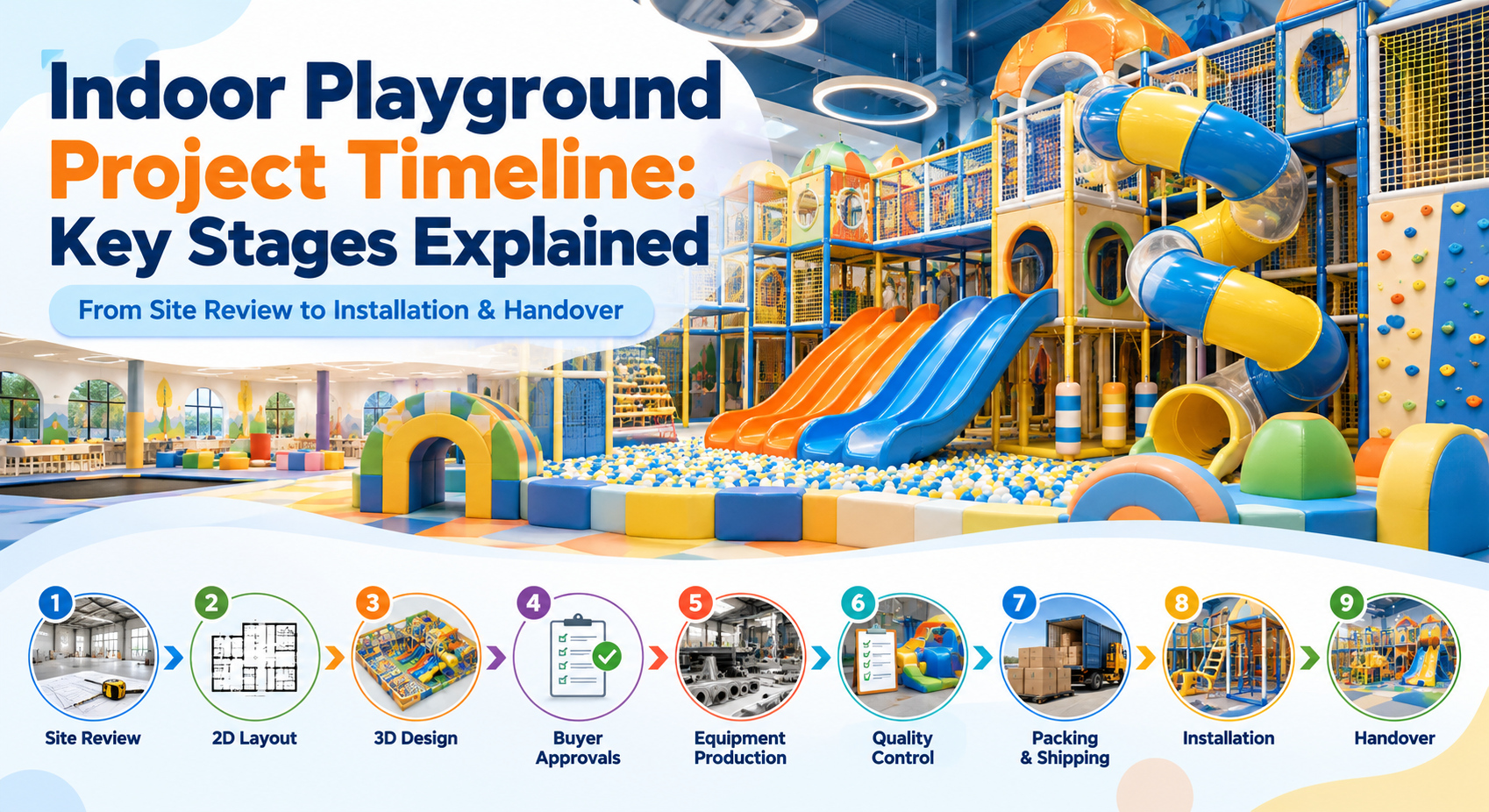
An indoor playground project timeline should separate site review, 2D layout, 3D design, buyer approvals, equipment production, quality control, packing, shipping, installation, and handover. There is no reliable universal schedule for every project because the scope, customization, site readiness, approval speed, production workload, shipping route, and local installation model differ. Buyers should ask for stage-by-stage milestones, the approval needed at each stage, and the dependencies that could delay the opening date.
How Long Does an Indoor Playground Project Take?
The total timeline is the sum of several connected stages, not just factory production. A project may lose time before manufacturing begins if site dimensions are incomplete, the attraction list keeps changing, or the buyer has not approved the drawings and materials. It can also be delayed after production if packing, freight booking, site readiness, or installation access has not been planned.
Ask the Commercial Playground Equipment supplier to define the start and finish conditions for each stage. A useful schedule identifies the responsible person, required input, approval deadline, dependency, and expected output. Dates should be treated as project-specific commitments, not copied from an unrelated installation.
What Project Requirements Must Be Ready Before Design?
The supplier needs a dimensioned floor plan, usable area, clear height, columns, entrances, emergency exits, building services, and any landlord or construction restrictions. It also needs the venue type, target age groups, attraction priorities, theme direction, budget, preferred installation model, and planned opening date.
If site information is incomplete, the design may be based on assumptions that later require changes. Buyers should flag which dimensions are verified and which are preliminary. If the building is still under construction, agree how later site measurements will be checked against the approved drawings.
How Should 2D and 3D Design Approvals Be Scheduled?
The 2D layout should settle functional questions first: zones, footprints, circulation, entrances, exits, supervision points, queues, support spaces, and maintenance access. Once the main layout is stable, 3D visuals can communicate theme, colors, decorative features, scale, and the intended customer experience.
Approval should be recorded clearly. Buyers should confirm the layout, equipment schedule, materials, colors, and any custom features before production release. Changes after approval should follow a documented process that states the potential impact on cost, drawings, production, packing, and delivery.
What Affects Equipment Production and Quality Control?
Production workload depends on the size and complexity of the project, the number of custom components, material availability, interactive systems, special finishes, and the approved equipment schedule. A simple standard module and a highly themed multi-zone structure do not have the same production requirements.
Quality control should have defined checkpoints. Depending on the equipment, these may include dimensional checks, component fit, padding and cover inspection, labels, interactive-system checks, packing-list confirmation, and final review. Ask what records or photos can be shared and how non-conforming parts or approved changes are documented.
How Should Packing and Shipping Be Planned?
Packing begins with an accurate equipment and component list. Labels should make it possible to identify packages and connect them to installation zones or drawings. Buyers should confirm how fragile, oversized, or custom decorative components will be protected and whether spare parts are included in the shipment.
Shipping time depends on the origin and destination, transport mode, route, port conditions, documentation, customs procedures, and booking availability. These factors should be tracked separately from production. Confirm who handles export documents, freight booking, import clearance, unloading, and delivery to the venue.
What Does Installation and Handover Require?
Installation readiness includes a finished and accessible site, a clear unloading route, suitable storage, required local labor or technicians, tools, power access where needed, and current drawings. If the supplier provides on-site installation, remote guidance, or a technical supervisor with local labor, the agreement should state the exact model.
Handover should identify outstanding corrections, missing parts, final drawings, equipment schedules, maintenance guidance, spare-parts references, warranty contacts, and operating instructions included in the contract. The opening date should allow time for inspection, cleaning, staff preparation, and any required local approvals.
What Can Delay Delivery and How Can Buyers Keep the Project on Schedule?
Common causes include late site measurements, repeated design revisions, delayed color or material approvals, changes to the equipment list, incomplete payment or shipping documents, restricted delivery access, and building work that is not ready for installation. Some risks are within the buyer’s control and should be tracked before they become urgent.
Hold regular milestone reviews and maintain one shared list of decisions, owners, due dates, and changes. Escalate any issue that affects the critical path. A realistic schedule is not one with the fewest days on paper; it is one that links approvals, production, logistics, and site readiness in a sequence the project team can actually deliver.
Decision Table: What Buyers Should Compare
| Project Stage | Main Output | Buyer Confirmation |
| Site review | Verified site inputs and constraints | Dimensions, height, columns, exits and services |
| 2D and 3D design | Approved layout and visual concept | Zones, equipment list, materials and theme |
| Production and QC | Manufactured components and inspection records | Scope matches approved drawings |
| Packing and shipping | Labeled packages and shipping documents | Freight, customs and unloading responsibilities |
| Installation and handover | Installed equipment and handover package | Corrections, maintenance, spare parts and support |
What Information Should Buyers Prepare?
Prepare the destination country and city, venue type, dimensioned floor plan, usable area, clear height, columns, entrances and emergency exits, target age groups, preferred attractions, theme direction, budget range, installation preference, and planned opening date. For a more accurate review, also provide any landlord restrictions, site photos, and the current building or CAD drawings available.
Common Mistakes to Avoid
- Starting the timeline before site information and project scope are stable.
- Treating production time as the entire project timeline.
- Approving 3D visuals without confirming the equipment schedule.
- Leaving shipping, unloading, and customs responsibilities unclear.
- Setting the opening date without installation and handover buffer.
Frequently Asked Questions
How long does an indoor playground project take?
It depends on scope, customization, approvals, production, shipping, site readiness, and installation. Request a stage-by-stage schedule for the specific project.
How long does equipment production take?
Production time depends on the approved equipment mix, custom components, material availability, and factory workload. It should be confirmed in the project schedule.
How long does shipping take?
Shipping depends on destination, route, transport mode, booking, documentation, customs, and local delivery conditions.
How long does installation take?
Installation depends on equipment complexity, site readiness, labor, access, and the agreed installation model.
When should equipment be ordered?
Start supplier discussions early enough to confirm site requirements, design approvals, production dependencies, shipping, and installation before the planned opening.
Commercial Buyer Checklist
- Timeline starts from a defined milestone
- Site dimensions and constraints verified
- 2D layout and 3D concept approval dates set
- Final equipment schedule confirmed
- QC checkpoints and records agreed
- Packing labels and list confirmed
- Shipping and customs responsibilities assigned
- Installation site-readiness plan prepared
- Handover documents defined
- Opening schedule includes a contingency buffer
Final Thoughts
Indoor Playground Project Timeline: Key Stages Explained should be treated as a project decision supported by site data, written scope, and realistic operating assumptions. NanPlay recommends connecting design, equipment specifications, delivery responsibilities, and maintenance planning before the project is released for production.
Project CTA
To review a project schedule, send the floor plan, clear height, columns and exits, attraction list, destination country, preferred installation model, and target opening date.
Reference: https://www.nanplay.com/indoor-playground/