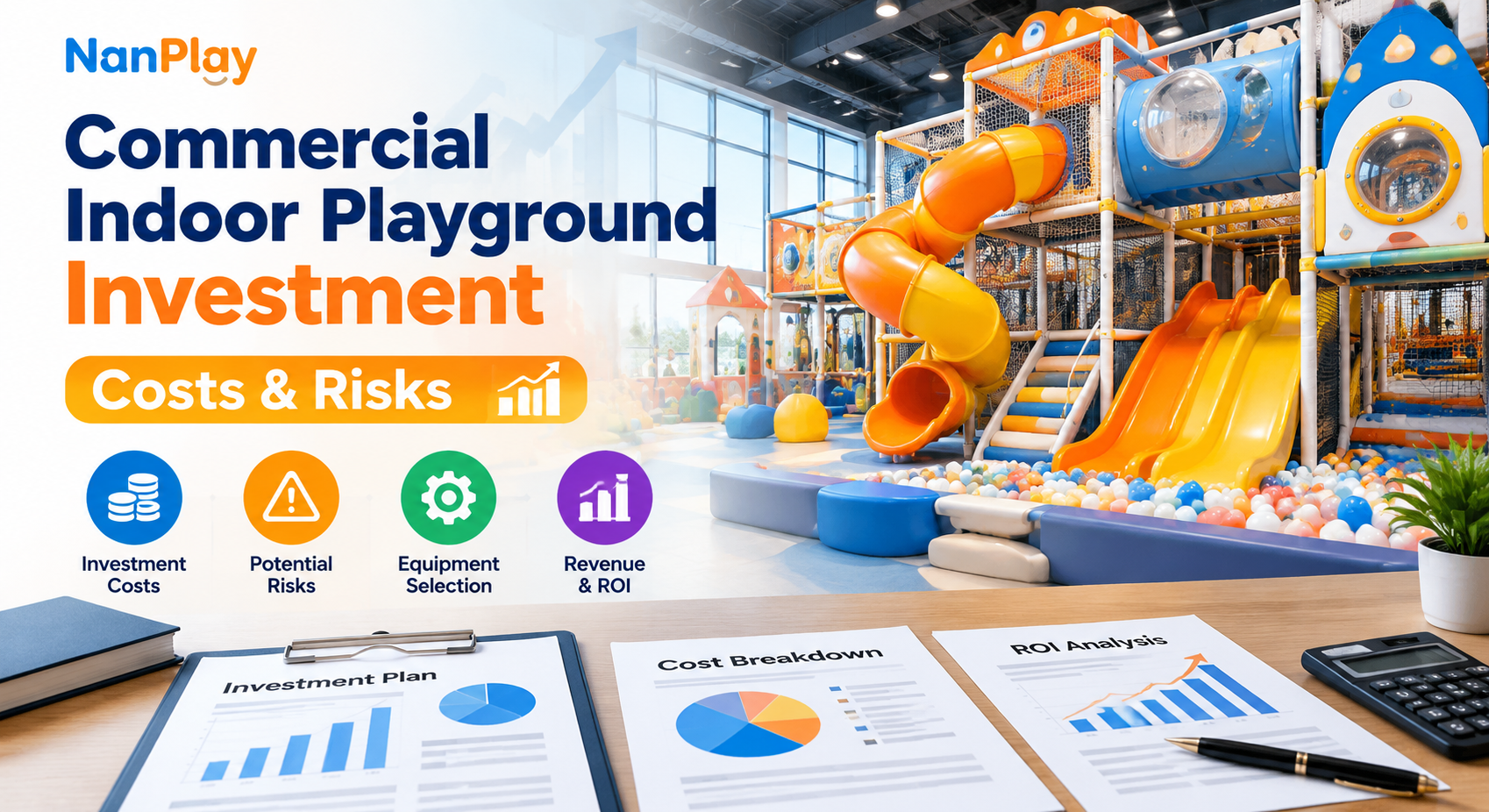
Commercial Indoor Playground Investment: Costs & Risks
2026年10月28日 / By safekidsplay_admin
Quick Answer
Investing in indoor playground equipment should begin with the business model, the real venue, and the customer groups—not with a catalog or a headline equipment price. Investors need to separate venue lease and fit-out, equipment and custom design, shipping, installation, pre-opening preparation, and ongoing operating costs. The equipment mix should fit the available floor area, clear height, target ages, local market, and staffing plan. Profitability and payback cannot be guaranteed by a supplier; they must be estimated using the investor’s own pricing, attendance, cost, and financing assumptions.
Is a Commercial Indoor Playground a Good Investment?
A commercial indoor playground can be a viable business when local demand, site access, rent, customer experience, operating capability, and repeat-visit opportunities work together. The equipment is only one part of the investment. A venue with attractive equipment can still struggle if it is difficult to reach, poorly zoned, expensive to operate, or not matched to the families in its catchment area.
Before committing capital, test the business concept against the local market. Identify the primary audience, nearby competitors, expected visit occasions, party demand, school or group opportunities, and the price range customers may accept. These are planning questions for the investor to validate; they should not be replaced by generic revenue promises.
How Should Buyers Build an Investment Budget?
Create separate budget lines for the lease or property, building renovation, equipment, custom design, export packing, freight, unloading, installation, local contractor work, permits or professional services where applicable, opening inventory, staff training, marketing, insurance, and working capital. Not every project has the same scope, so each line should be marked as confirmed, estimated, or still requiring a quotation.
Ask an Indoor Playground Supplier to define what is included in the equipment proposal. A quote may include design and manufacturing while excluding freight, customs charges, unloading, building works, electrical work, fire systems, or local approvals. These exclusions can materially change the total capital requirement.
What Indoor Playground Equipment Should Investors Choose?
Choose attractions around the venue’s primary customer group and operating model. A family-focused concept may combine a multi-level play structure, slides, climbing, ball play, a toddler zone, and parent seating. A venue targeting older children may consider selected challenge or interactive activities where the building and supervision plan support them.
Each attraction should have a clear purpose: attract the intended user, encourage repeat visits, support parties or groups, or strengthen the venue’s identity. Avoid adding equipment only to make the floor plan look full. Every zone also needs circulation, staff visibility, cleaning access, and maintenance space.
How Does Project Size Affect Investment?
Total area influences the amount of equipment that can be installed, but square meters alone do not determine cost. Ceiling height, building columns, structural interfaces, theme complexity, custom features, equipment intensity, access routes, and installation conditions also affect the project scope.
Compare concepts using the same site information. A larger venue may require more attractions and support functions, while a smaller venue may need a carefully prioritized mix. Both should retain space for reception, queues, parent areas, exits, storage, and service access rather than treating all usable floor area as play space.
How Should Investors Estimate Revenue and Operating Costs?
Build a conservative operating model from revenue streams the venue can realistically support. These may include admission, memberships, birthday parties, group bookings, events, food and beverage, or other permitted services. Estimate each stream separately and document the assumptions behind visits, average spend, operating days, party utilization, and seasonal variation.
Then list recurring costs such as rent, payroll, utilities, cleaning, repairs, replacement parts, marketing, insurance, software, payment fees, and local operating expenses. Use low, expected, and high scenarios. A supplier can explain equipment options, but the investor should validate demand and operating assumptions with local market research.
How Should an Indoor Playground Supplier Be Evaluated?
Review the supplier’s ability to translate a real floor plan into a workable design, provide clear equipment specifications, explain manufacturing and quality-control steps, coordinate packing and delivery, and define installation and after-sales responsibilities. Ask for evidence that relates to the proposed project rather than relying only on general factory photos or broad claims.
Before placing an order, compare quotations line by line. Check the equipment schedule, materials, custom items, drawings, packing, shipping assumptions, installation model, spare parts, warranty terms, payment milestones, and change-control process. The best comparison is based on scope and evidence, not simply the lowest initial number.
How Should Buyers Assess ROI Without Relying on Promises?
Use a transparent model that separates initial investment, operating performance, financing, tax, and cash flow. One simplified measure is annual operating profit divided by the defined investment base, but the result depends on what costs are included. A payback estimate can be calculated by dividing the relevant initial investment by expected annual net cash flow; this is only as reliable as the assumptions entered.
Run sensitivity tests for lower attendance, slower party sales, higher rent, delayed opening, unexpected maintenance, and changes in pricing. Do not treat a supplier’s equipment proposal as a guarantee of profitability. The equipment’s role is to support the customer experience and operations; commercial results depend on the whole business.
Decision Table: What Buyers Should Compare
| Budget Area | Items to Include | Questions to Confirm |
| Venue and fit-out | Lease, flooring, lighting, building changes and local works | Which items are landlord or owner responsibilities? |
| Equipment and design | Attractions, custom theme, drawings and specifications | Does the quote match the final equipment schedule? |
| Logistics and installation | Packing, freight, unloading, local labor and assembly | Which costs are included and which are excluded? |
| Pre-opening and operations | Staffing, training, insurance, cleaning, marketing and working capital | How much cash is needed before revenue stabilizes? |
What Information Should Buyers Prepare?
Prepare the destination country and city, venue type, dimensioned floor plan, usable area, clear height, columns, entrances and emergency exits, target age groups, preferred attractions, theme direction, budget range, installation preference, and planned opening date. For a more accurate review, also provide any landlord restrictions, site photos, and the current building or CAD drawings available.
Common Mistakes to Avoid
- Using a generic cost-per-square-meter figure as a final budget.
- Assuming equipment cost includes freight, unloading, local works, and installation.
- Forecasting revenue without testing local demand and seasonality.
- Adding attractions without accounting for staffing and maintenance.
- Treating ROI or payback as guaranteed rather than assumption-dependent.
Frequently Asked Questions
How much does an indoor playground equipment investment cost?
The total depends on the venue, attraction mix, customization, building work, shipping, installation, and local operating setup. A project-specific scope is needed for a useful estimate.
Is a commercial indoor playground profitable?
It can be, but profitability depends on local demand, rent, pricing, attendance, parties, payroll, maintenance, and management. No equipment package can guarantee a result.
What equipment is needed for an indoor playground?
The mix depends on target ages and the business model. Common options include multi-level play, slides, climbing, soft play, toddler activities, ball play, and selected interactive attractions.
How long is the payback period?
There is no universal payback period. It should be calculated from the investor’s verified initial investment and realistic net cash-flow assumptions.
What should be sent to an indoor playground supplier?
Provide the country and city, venue type, floor plan, area, clear height, columns, exits, target ages, preferred attractions, theme, budget, and opening date.
Commercial Buyer Checklist
- Local customer demand assessed
- Business model and target ages defined
- Floor area and clear height verified
- Full investment categories listed
- Equipment scope matches the layout
- Quote inclusions and exclusions compared
- Revenue and operating assumptions documented
- Low, expected, and high scenarios tested
- Maintenance and replacement costs included
- Opening plan and working capital reviewed
Final Thoughts
Indoor Playground Equipment Investment: Costs & Risks should be treated as a project decision supported by site data, written scope, and realistic operating assumptions. NanPlay recommends connecting design, equipment specifications, delivery responsibilities, and maintenance planning before the project is released for production.
Project CTA
For a project-specific equipment proposal, share the destination country and city, venue type, floor plan, usable area, clear height, columns and exits, target age range, preferred attractions, theme direction, budget range, and planned opening date.
Reference: https://www.nanplay.com/indoor-playground/