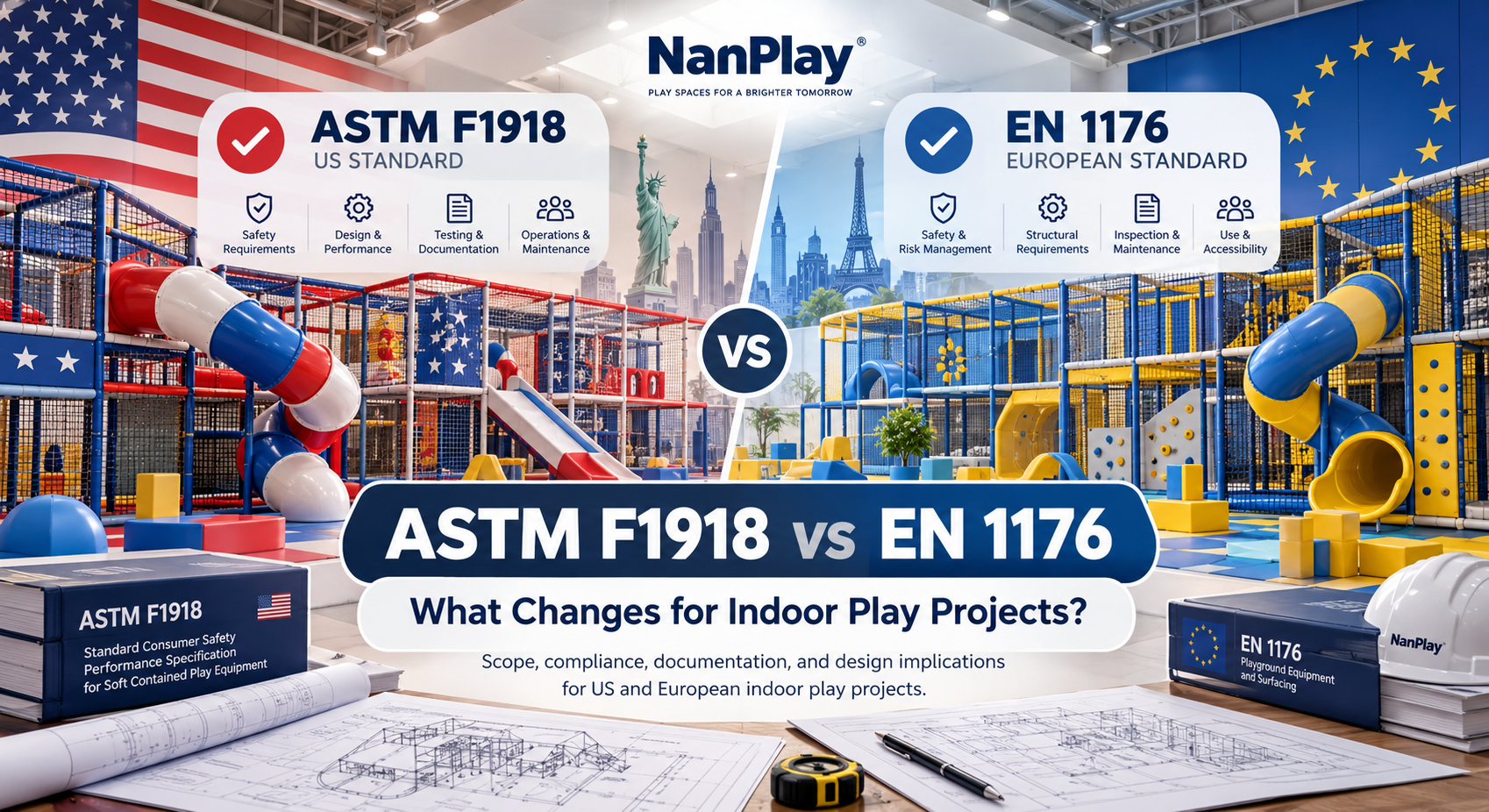
ASTM F1918 vs EN 1176: What Changes for Indoor Play Projects?
2026年10月26日 / By safekidsplay_admin
Quick Answer
For buyers comparing US and European indoor-play requirements, ASTM F1918 and EN 1176 should be evaluated as part of a complete commercial project rather than as a stand-alone product choice. International buyers, engineers, FEC investors, and procurement teams should define scope rather than labels, market and equipment type, documents buyers should request, and design-stage implications before final approval. The equipment mix may include soft-contained play, fully enclosed play, slides/climbing, access points, and protective systems, but the final combination depends on the real building, target users, staffing, maintenance capability, destination-market requirements, and contract scope. The strongest proposal is the one that connects design, specifications, manufacturing evidence, installation responsibilities, and long-term operation.
What Is the Practical Difference Between ASTM F1918 and EN 1176?
ASTM F1918 and the EN 1176 family should be understood by scope rather than by marketing label. Buyers should identify the destination market, the type of contained or enclosed play equipment, the project edition or contractual requirement, and the evidence expected by the local project team.
The practical purchasing question is not ‘Which standard is better?’ It is ‘Which requirements apply to this equipment in this market, what documentation can the supplier provide, and what remains the responsibility of the local building and operating project?’
How Should Buyers Identify the Correct Scope?
Safety and compliance discussions should start with market, equipment type, and project scope. A soft-contained play structure, a fully enclosed play system, and a trampoline zone may involve different requirements and documents. One certificate should not be presented as universal evidence for every component or every country.
Equipment requirements also do not replace building, fire, accessibility, insurance, operating, or landlord requirements. Buyers should coordinate the equipment documentation with qualified local professionals and authorities where required.
What Design Information Changes by Market?
The building should control the equipment plan, not the other way around. When buyers compare US and European indoor-play requirements, clear height, columns, entrances, emergency routes, floor conditions, mechanical systems, and loading access can all change what is practical.
Buyers should identify site constraints early enough that they can be solved in the layout rather than hidden by decoration. If local professionals, landlords, insurers, or authorities need to approve part of the project, those responsibilities should be separated from the equipment supplier’s scope.
What Documents Should a Supplier Provide?
Commercial buyers should connect visual design with project-specific specifications. For ASTM F1918 and EN 1176, useful specifications may cover structure, soft protection, panels, nets, moving or interactive components, surface finishes, attachment methods, and replaceable wear parts where relevant.
Broad phrases such as ‘commercial grade’ or ‘international standard’ are not enough by themselves. The buyer should know what is actually supplied, how the component is identified, and what evidence supports the agreed scope. Where destination-market requirements apply, the supplier should state the equipment and market scope rather than imply one document covers the whole venue.
Which Responsibilities Remain Local?
Safety and compliance discussions should start with market, equipment type, and project scope. A soft-contained play structure, a fully enclosed play system, and a trampoline zone may involve different requirements and documents. One certificate should not be presented as universal evidence for every component or every country.
Equipment requirements also do not replace building, fire, accessibility, insurance, operating, or landlord requirements. Buyers should coordinate the equipment documentation with qualified local professionals and authorities where required.
How Should Standards Be Reviewed Before Production?
Once the layout is approved, the project needs a controlled handoff into manufacturing. Useful evidence can include current applicable standards references, project-specific test/document scope, and local professional review. The objective is to show that the equipment being produced matches the approved drawings and equipment schedule.
Part labeling, trial fitting, dimensional checks, packing references, and change records are especially important for customized projects. If the buyer requests a late change, the supplier should explain the effect on drawings, cost, production sequence, packing, and delivery instead of accepting informal changes without documentation.
What Information Should Buyers Prepare?
Prepare the destination country and city, venue type, dimensioned floor plan, clear height, columns and exits, target age or user groups, preferred attractions, theme direction, staffing and supervision assumptions, installation preference, budget range, and planned opening date. For this topic, also provide information about scope rather than labels; market and equipment type; documents buyers should request; design-stage implications. A floor plan or CAD file is strongly preferred because it allows the supplier to move from general advice to a project-specific layout.
Common Mistakes to Avoid
- Assuming one certificate or standard applies to every component, venue, and country.
- Comparing proposals only by headline price or equipment count instead of complete scope.
- Treating a 3D rendering as proof that all shown items are included in the quotation.
- Ignoring staff sightlines, cleaning, inspection, and maintenance access until after installation.
- Treating equipment documentation as a substitute for building, fire, insurance, or local approval.
Frequently Asked Questions
What information should buyers provide before discussing ASTM F1918 and EN 1176?
Provide the destination market, floor plan, usable area, clear height, columns and exits, target users, preferred activities, budget direction, and planned opening date. Project-specific constraints are more useful than a general request for a catalog.
Should buyers choose the proposal with the most attractions?
Not automatically. A stronger proposal gives each zone a clear role and leaves enough space for circulation, supervision, maintenance, and support functions.
How important are 2D and 3D drawings?
Both are useful for different reasons. The 2D plan is better for dimensions, zoning, flow, and building constraints, while 3D visuals communicate theme, scale, and the intended customer experience.
What should buyers verify before production begins?
Verify the final layout, equipment schedule, major specifications, colors or theme where applicable, documentation requirements, price scope, change process, packing, installation responsibilities, spare parts, and warranty terms.
Who confirms local building and operating requirements?
The buyer should coordinate with qualified local professionals, landlords, insurers, and authorities where required. The equipment supplier needs accurate project information so the equipment scope can be coordinated with those requirements.
Commercial Buyer Checklist
- Destination market and venue type confirmed
- Dimensioned floor plan and clear height verified
- Target users and zone roles defined
- 2D circulation and staff/parent sightlines reviewed
- Equipment schedule matches the visual concept
- Major materials and component specifications documented
- Manufacturing/QC evidence and change process defined
- Packing, shipping and installation responsibilities written
- Inspection, maintenance and spare-parts plan prepared
- Warranty and local-project responsibility boundaries confirmed
Final Thoughts
ASTM F1918 vs EN 1176: What Changes for Indoor Play Projects? should ultimately be treated as a project-planning decision, not a catalog-selection exercise. NanPlay recommends starting with the real building and operating model, then connecting the layout to written specifications, manufacturing evidence, installation responsibilities, and long-term maintenance. That approach gives commercial buyers a clearer basis for comparing suppliers and reduces the number of assumptions that remain unresolved when production starts.
Reference: https://www.nanplay.com/safety-commitment