Montessori Playground Equipment: How to Plan a Calm, Purposeful Indoor Zone
2026年9月4日 / By safekidsplay_admin
Full English Article | NanPlay
Primary Keyword: montessori playground equipment
Quick Answer
Montessori-inspired playground equipment should support purposeful movement, independent exploration, simple choices, and a calmer visual environment. For a commercial indoor venue, the design still has to meet practical needs such as age zoning, supervision, cleaning, circulation, maintenance, and applicable local requirements. The concept should influence how the space is organized, not become a decorative label.
What Does a Montessori-Inspired Play Zone Try to Achieve?
The goal is usually to give children understandable activities that encourage movement, coordination, problem-solving, and independent choice without overwhelming the space. Equipment should be selected for what children can do with it, not simply for how many themed elements can fit into the room.
- Independent movement
- Coordination
- Open-ended exploration
- Simple choices
- Clear activity purpose
How Can the Visual Environment Stay Calm?
Commercial play spaces often use strong colors and dense decoration. A Montessori-inspired zone can use a more restrained palette, natural-looking textures, clearer organization, and fewer competing visual elements. The exact style should still fit the brand and cleaning requirements of the venue.
- Restrained colors
- Simple forms
- Clear boundaries
- Organized storage
- Consistent materials
Which Activities Fit the Concept?
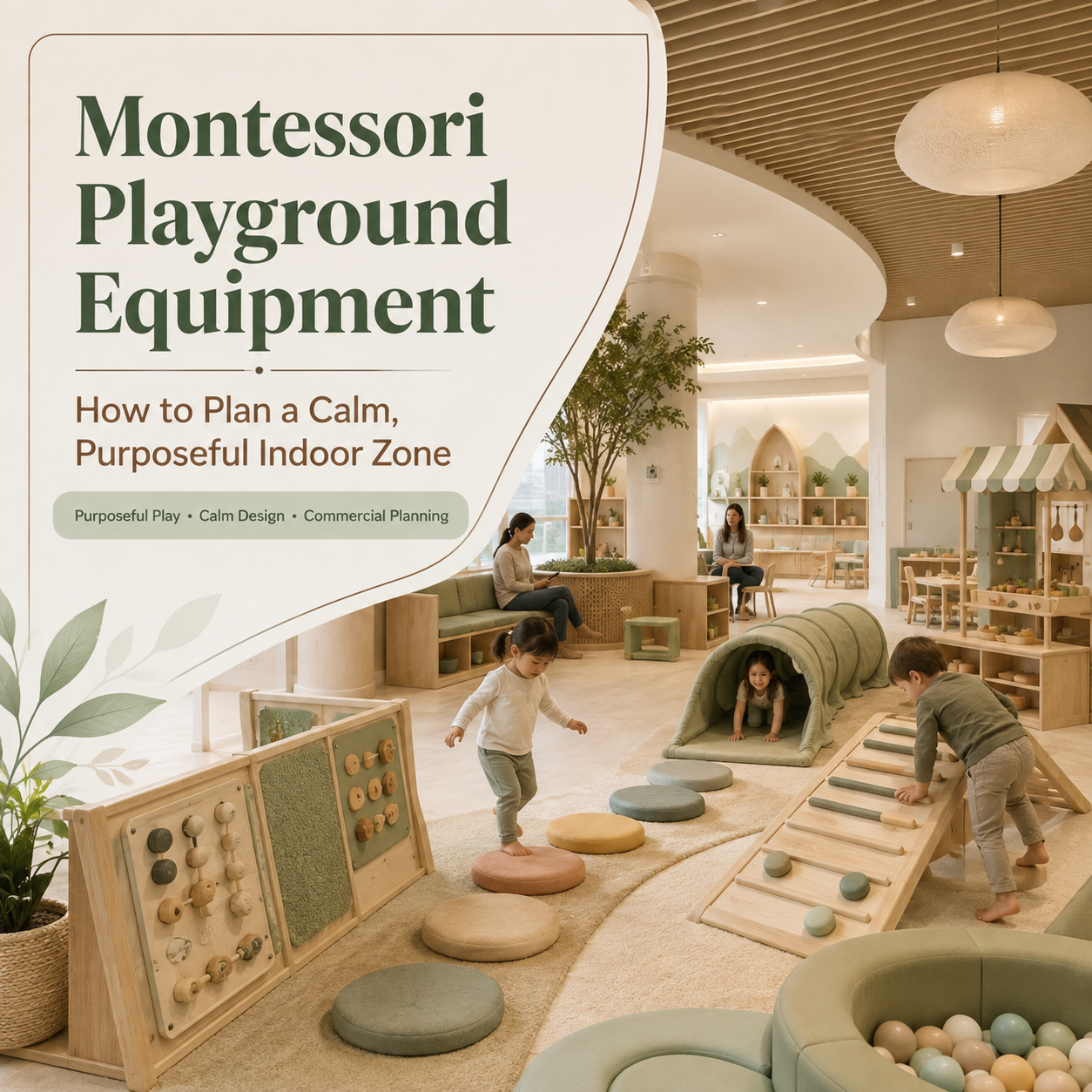
Low climbing, balance, stepping, crawling, tactile panels, role-play, loose soft elements, and simple movement challenges can all support purposeful play when they match the target age. Activities should have a clear difficulty level and should not create unnecessary conflicts between children moving at very different speeds.
- Balance
- Low climbing
- Crawling
- Sensory/tactile play
- Simple role-play
How Should the Layout Support Independence and Supervision?
Children should be able to understand where an activity begins and ends, while adults and staff maintain clear sightlines. Paths should be readable, low-height zones should remain visible, and parent seating should not block circulation. Independence for the child and supervision for the operator can be designed together.
- Readable paths
- Low-height sightlines
- Clear entries
- Parent visibility
- Unblocked circulation
What Materials and Maintenance Questions Matter?
Commercial use requires durable, cleanable surfaces and replaceable high-wear parts. Buyers should ask how covers, padding, panels, flooring, connectors, and sensory elements are cleaned or replaced. A calm design is only useful if the operator can keep it in good condition.
- Cleanable covers
- Replaceable wear parts
- Protected edges
- Accessible fasteners
- Maintenance instructions

How Should the Concept Be Adapted to a Real Venue?
Not every room can support the same layout. Ceiling height, columns, exits, age mix, parent seating, party functions, and local requirements should shape the final design. The concept should be translated into the real building instead of copied from a residential playroom or a social-media image.
- Real floor plan
- Target age
- Venue type
- Operational needs
- Local requirements
What Information Should Buyers Prepare?
Prepare the destination country, venue type, floor plan, usable area, clear ceiling height, columns and exits, target age groups, preferred activities, theme direction, budget range, and planned opening date. These inputs help turn a general product discussion into a project-specific layout and scope.
Common Mistakes to Avoid
- Choosing from a catalog before the real site and user group are defined.
- Comparing headline prices when the quotations include different scopes.
- Approving a visual concept without checking circulation, supervision, maintenance, and installation access.
- Using broad compliance or quality claims instead of project-specific documents and specifications.
- Waiting until after opening to plan spare parts, inspections, cleaning, records, or local operating requirements.
Frequently Asked Questions
What Does a Montessori-Inspired Play Zone Try to Achieve?
The goal is usually to give children understandable activities that encourage movement, coordination, problem-solving, and independent choice without overwhelming the space. Equipment should be selected for what children can do with it, not simply for how many themed elements can fit into the room.
How Can the Visual Environment Stay Calm?
Commercial indoor playground spaces often use strong colors and dense decoration. A Montessori-inspired zone can use a more restrained palette, natural-looking textures, clearer organization, and fewer competing visual elements. The exact style should still fit the brand and cleaning requirements of the venue.
Which Activities Fit the Concept?
Low climbing, balance, stepping, crawling, tactile panels, role-play, loose soft elements, and simple movement challenges can all support purposeful play when they match the target age. Activities should have a clear difficulty level and should not create unnecessary conflicts between children moving at very different speeds.
How Should the Layout Support Independence and Supervision?
Children should be able to understand where an activity begins and ends, while adults and staff maintain clear sightlines. Paths should be readable, low-height zones should remain visible, and parent seating should not block circulation. Independence for the child and supervision for the operator can be designed together.
What Materials and Maintenance Questions Matter?
Commercial use requires durable, cleanable surfaces and replaceable high-wear parts. Buyers should ask how covers, padding, panels, flooring, connectors, and sensory elements are cleaned or replaced. A calm design is only useful if the operator can keep it in good condition.
Commercial Buyer Checklist
- Define the educational/play goals
- Keep the visual system simple and consistent
- Choose age-appropriate purposeful activities
- Maintain clear adult sightlines
- Use commercial-grade cleanable materials
- Plan replacement and maintenance access
- Adapt the concept to the real building
Final Thoughts
For commercial buyers, Montessori playground equipment is most useful as a planning approach: purposeful activities, understandable spaces, restrained visual language, and practical supervision. The final project still has to work as a commercial venue every day.
Reference: https://www.nanplay.com/blog/montessori-indoor-playground-design